
How to pack a kitchen like a professional mover.
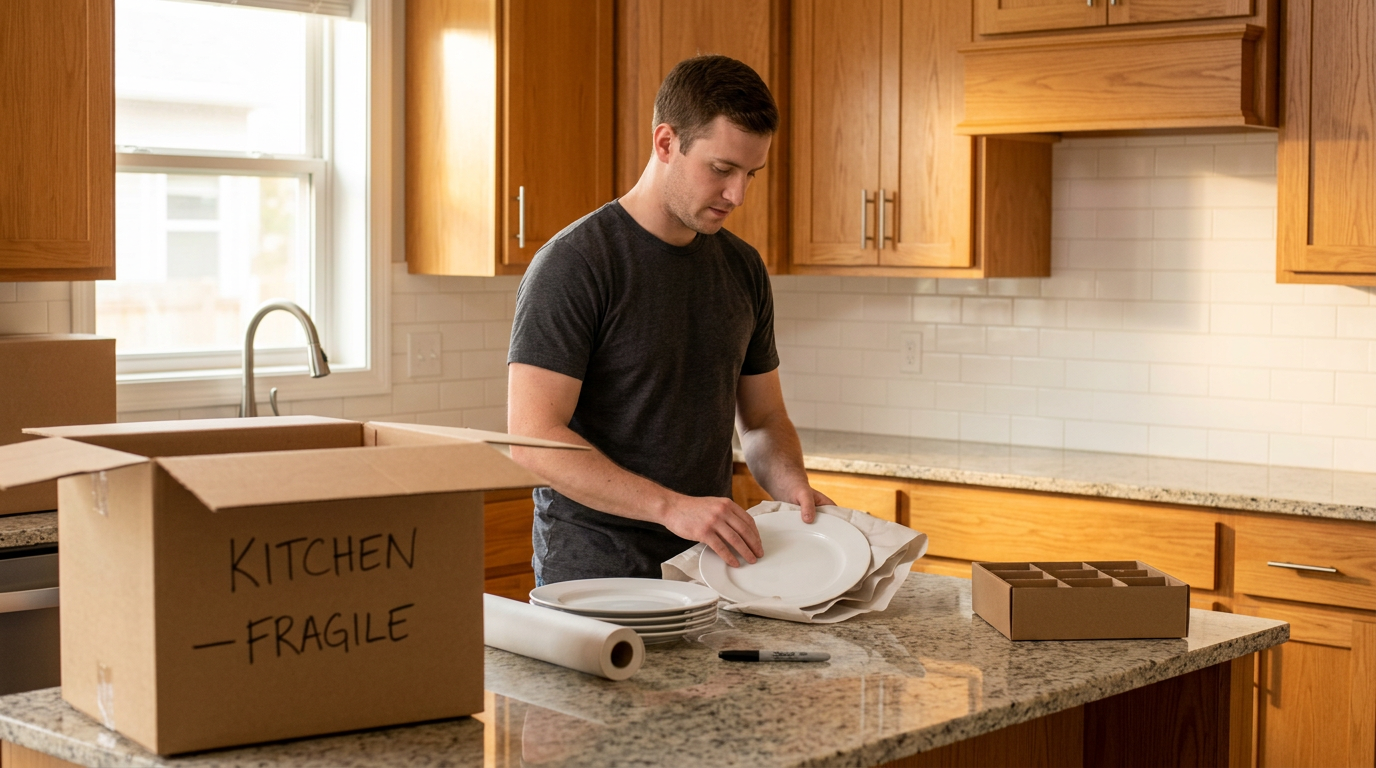
Every mover has a broken-glass story. Ours involves an heirloom gravy boat, a bath towel labeled "kitchen — fragile," and a very quiet ten-second car ride. Here's how to make sure your kitchen doesn't become somebody else's cautionary tale.
The kitchen is the room that eats moving days for lunch. It's not the biggest, but it holds the highest ratio of fragile-to-heavy-to-weird items in the house. Nine cookbooks, a stand mixer, a cast-iron skillet that would concuss a linebacker, and a drawer full of things nobody can name.
If you pack the kitchen right, the entire move goes faster. If you don't, you're eating takeout for a week and scrubbing turmeric out of the dish towels you used as padding. Here's the professional playbook.
Give the kitchen a full weekend, not an evening. Use real dish-pack boxes with cell dividers, wrap every single glass and plate in packing paper (never newspaper — the ink transfers), and pack the pantry last so you can keep cooking until day-of.
The supplies list — nothing fancy, all necessary
You can pack a kitchen with garbage bags and prayer. We do not recommend it. Real supplies are $40 at U-Haul or a local box store and they save you six broken items on the other end:
- 5–8 dish-pack boxes. Double-walled small boxes with cardboard cell dividers. This is the one item you should not cheap out on.
- 4–6 medium boxes. For pantry goods, small appliances, and cookbooks.
- 2–3 large boxes. Lightweight bulky items only: Tupperware, mixing bowls, colanders.
- One roll of unprinted packing paper (25 lb). Newspaper transfers ink to porcelain. Your grandmother's china deserves better than yesterday's headlines.
- Bubble wrap. A small roll for stemware and anything hand-blown or heirloom.
- Packing tape gun and 3 rolls of tape. Not painter's tape. Not duct tape. Clear packing tape.
- Thick permanent marker. Label every side of every box.
The order of operations (do these in this order)
- Purge first. The half-empty bottle of chipotle powder from 2019 is not going with you. Neither are the four water bottles missing lids. Trash bag first, boxes second.
- Pack "never-use" items 1–2 weeks out. China cabinet, holiday servingware, the fondue set. Get them off the field early.
- Pack "sometimes-use" items 3–5 days out. Baking pans, blender, second set of dishes.
- Pack "everyday" items the night before. Coffee maker last, always. Nobody survives moving day without a coffee maker.
- Pantry, morning of. Anything shelf-stable in a small box. Everything cold in a cooler with ice.
The dish-pack technique the pros use
Plates go on their edge, not stacked flat. Here's the pattern:
- Line the bottom of the dish pack with 2–3 inches of crumpled packing paper.
- Wrap each plate individually in a single sheet of packing paper. Tuck the ends under.
- Stand plates vertically in the box, like records in a crate. Vertical plates survive drops that flat-stacked plates never do.
- Fill any gap with more crumpled paper. When you shake the closed box gently and hear nothing move, you did it right.
- Cell dividers on top for glasses and mugs. Each glass gets its own cell, wrapped in paper, open end down.
Label it "KITCHEN — DISHES — FRAGILE" on the top and both sides. A dish pack that says "kitchen" and nothing else lands upside down in a stack, every time.
The stuff that trips people up
Knives
Wrap the blade in a piece of cardboard, tape it, then wrap the whole thing in a dish towel and label it "KNIVES — SHARP." Never toss loose knives in a box of Tupperware. A surprise injury is not how you want to kick off move-in day.
Stand mixer and heavy small appliances
If you kept the original box, use it. If not, wrap the appliance in a blanket, put it in a medium box surrounded by crumpled paper, and mark the weight on the outside. A stand mixer weighs 25 pounds and surprises everyone who lifts it.
Pots and pans
Nest them like Russian dolls with paper between each one. Lids in a separate small box. Cast-iron in its own box, alone, on the bottom of the stack. Cast-iron is heavier than the box it's in — treat it like a barbell.
Wine and liquor
A wine box from a liquor store with cardboard dividers is purpose-built for this. Bubble wrap around expensive bottles. Do not pack open bottles — they leak in the truck 100% of the time.
Spices
Rubber-band the caps down and pack them upright in a small box. Half our estate cleanouts include one shelf that smells permanently of cinnamon. Don't let that be you.
What we won't move (and neither will any legitimate mover)
Hazmat rules are federal, not us being fussy. Deal with these separately or dispose of them:
- Propane tanks (even small camping ones)
- Cooking oils and vegetable shortenings — they leak in the KC summer heat
- Cleaning chemicals: bleach, ammonia, drain cleaner
- Aerosols: cooking spray, air freshener, oven cleaner
- Opened liquor bottles (see above)
- Any produce, meat, or dairy — even in a cooler on a same-day move, it's a gamble
The 20-minute unpack-first plan
Before the crew leaves, unpack one specific box — the "kitchen essentials" box you packed last the night before. In it: coffee maker, one mug per person, kettle or coffee filters, silverware for four, one pan, one plate per person, hand soap, dish soap, one dish towel, a roll of paper towels, and a spare trash bag. That's dinner and breakfast covered. Everything else can wait.
Or… you could just pay us
The kitchen is the one room where partial packing pays for itself. A two-mover crew packs an entire family kitchen in 2–3 hours, with dish packs we bring, using the techniques above. It's the single most-requested add-on we do — for good reason. Get a firm quote at 816-988-1306, or start with the moving calculator for a full-home estimate.
Estimate boxes, truck size, and crew hours for your home in about 60 seconds.
Open calculator816-988-1306 — most callers get a firm number in under five minutes.
Call nowQuick answers
How long does it take to pack a kitchen?
A fully-stocked family kitchen takes 4 to 8 hours to pack properly, spread over one or two evenings. Studio kitchens are 1–2 hours. Give yourself a full weekend if you cook a lot, entertain, or have a china cabinet.
How many boxes do I need for my kitchen?
Plan on 5–8 dish packs (small heavy-duty boxes with cell dividers), 4–6 medium boxes for pantry and appliances, and 2–3 large boxes for lightweight bulky items like Tupperware and mixing bowls. Add a wardrobe box if you have hanging kitchen linens or an apron collection.
What can't I pack in a moving box?
Anything liquid, flammable, or perishable. That's cooking oils, propane, bleach, opened wine, half-full spice jars with volatile oils, and — always — the fridge/freezer contents. Movers won't touch hazmat and won't insure boxes marked mystery. Eat it, gift it, or trash it.
Should I pay a mover to pack my kitchen?
It's the room most worth paying for. A professional crew packs a family kitchen in 2–3 hours with a fraction of the breakage rate. If you're paying for any partial packing, put the kitchen first — the pantry and the closets come after.